
Adventure on the high seas.
Anybody still have their “Question Authority” T-shirt from the ‘70s? In these peaceful times there is little authority for anyone to question. A modern supervisor is barely an equal. Using a cell phone while on the clock, is a God-given right. And punishment for insubordination is to delegate simpler tasks with greater rewards.
I am an old fart. I grew up when corporal punishment was the norm. In grade school, the rod was mightier than the child. At fiddle lessons, my instructor would reach over the music stand and whack my hand with his bow when I neglected the “elbow under—thumb bent” rule. Now, even though I can’t play the fiddle worth a darn, I sure do know how to hold one.
With Gordon Ramsey as a notable exception, a chef now must cajole his apprentices, praise them for their lumpy puddings, acquiesce to their suggestions, and allow them to make their own mistakes.
When I was coming up in the kitchen, if you didn’t toe the line, you got your butt kicked—literally.
At sea, insubordination drew severe punishments: You could be keel-hauled, tarred, feathered and cast ashore, or flogged with the cat o’ nine tails, even hung from the yardarm. Arrg Billy, you will walk the plank while your shipmates cheer!


Yet even at sea, times have changed, and these severe penalties are frowned upon. It is not likely there will even be a brig to be thrown into. Most likely your captain will order the ship’s cook to make you a bowl of chicken soup. Then you will be asked politely to finish your watch and get to your bunk. Tomorrow is another day. The worst that can happen is that at the next port you’re off the ship Billy, and your long flight home will involve any number of stopovers—without hotels, on a ticket that is not entitled to a refund or changes.
The old saying, “Have you ever been to sea, Billy?”, is as much the brunt of many a bad joke involving a slippery bar of soap in the shower, as it is a question of experience. But it is really the captain’s only insight into his crew before the ship leaves the harbor. He needs to know who he can trust when the lines are cast off.
To keep everyone honest, the marine industry has created the Seaman’s Continuous Discharge Book. It is not a record of a sailor’s STD history, rather it’s a seaman’s log book – a kind of passport that ensures the captain that you do indeed have your sea legs.
I had signed on as the head cook on an eco-cruise ship in 1992. It was the trip of a lifetime, meaning the biggest part of the salary was the experience itself. In this case an opportunity to sail from Newfoundland down the west coast, through the Panama Canal, and then down the west coast of South America, around the horn to Antarctica, with all stops in between—and back. A holiday you might even say.
The ship’s crew was led by genuine officers, the captain and three mates, and a chief engineer with a second and third. Each officer had his own eager cadet. Read – the experience is the wage.
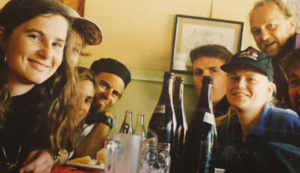
As head cook, I was an officer of the hospitality group, and my boss was the hotel manager. We had an eager crew of 12 kids, who were promised a job driving Zodiacs among the penguins and icebergs of Antarctica. I was the only one in that department that even knew what a Seaman’s Continuous Discharge Book was, or that even had one.
My eager galley assistant’s CV stated that she had cooked in a fishing camp somewhere up Vancouver Island. Nobody had bothered to asked if she had ever been to sea. The day we left St. Johns, was her first time on the big salt. As we cleared the narrows past Signal Hill, the first ground swell lifted our good ship’s bow, and then slammed us down again. A pan of bacon spilled a few drops of fat into the hot oven. A puff of burning bacon smoke, and two swells later, my assistant was green and gone from the galley.
As was everyone else. Except me. I knew it was an inner-ear balance thing, not a stomach thing. Staggering to the cooler, I grabbed the first thing I could reach A box of apple juice saved me. Downing it, the nausea left, and with it the need to puke and head to my bunk.
That first storm was a doozy. She was known as the Nor’easter of December 1992. That overnight sail to Bermuda is a story of it’s own. It ended up as 9 days and 9 nights of seafaring adventure. A one hand for you – one for the ship kind of adventure. The kind of adventure that can’t be qualified as a holiday no matter how you look at it. Sea time, not a holiday.
I had stocked a large quantity of Popsicles in four flavours. I knew that all sea-sick people will eat is Popsicles. Sweet water tastes so good after discharging your innards. Yes, I was ship’s doctor too—and eventually the barber. After five days pretty much everyone got tired of lying in their bunks, and faced the reality of life at sea.
But not my assistant. She sequestered herself to her bunk. Just leave me alone, I’ll be fine. No I don’t want to eat. Go away, I’m not hungry. The hotel manager, was up on the third day, but his heart wasn’t in it any more.
When we finally reached Bermuda, the sun rose on a beautiful day. The wind had died. It was flat calm all the way across the Atlantic to Africa. A glorious day to be at sea. The hotel manager, bag in his hand, his children on his mind, was on the gangway the moment it was dropped on Hamilton’s dock. Last we saw of him.
That made me the boss, and with my assistant out of commission, head office saw fit to rather send a second cook than a Hotel Manager. This landed Billy into my life. We’ll call him Billy, because that’s what you call the guy who is there. Buddy is the guy that isn’t there. Buddy left, Billy arrived.
Billy had been trained as a ship’s cook. One would assume he would have some sea experience. But the spine of his continuous discharge book was broken open by our captain, the day he boarded.
Even if he was a little shy on following orders, Billy was a good worker. And though our Canadian dialects were different, I thought we did communicate—kind of. He was young, proud, and a bit strong willed, I thought.
I asked him to cut up onions for onion soup, and he cut up carrots.
“I thought we’d have carrot soup,” was his answer.
“But Billy,” I said, “I’m supposed to make those decisions.”
“Don’t worry b’y, it’ll be alright.”
“Billy” I said, “We have a good selection of cold cuts, so let’s mix it up a bit for tomorrow’s lunch buffet. Don’t use Mortadella tomorrow. Is that alright with you?”
“Sure b’y,” he’d reply, and the next lunch buffet had exactly the same amount of exactly the same things as the day before.
“Ok, fine Billy. You make whatever soup you want, but the guests are asking if we have anything else besides Mortadella. We really ought to stop using Mortadella on the buffet for a while. I know it looks like bologna, but even the crew won’t eat it, because it ain’t Maple Leaf Bologna. So if the crew won’t eat it, and guests won’t eat it we have to stop using it?”
“OK b’y. That makes sense to me.”
I really believed he understood.
The next day the buffet was exactly the same.
I gave up. Letting go was easier than I thought. I just told the guests that they would have to talk to Billy if they wanted something different for lunch. After all, he was in charge of lunch, I was in charge of supper. Life was easier after that, and we had all settled in to our routines by the time we entered Chilean waters.
When a ship enters a new country, especially a producer of fresh fruit and vegetables like Chile, you risk quarantine if you bring in any fresh produce. Everything gets thrown overboard.
As we neared Valparaiso, our fridges were cleaned out and scoured with the exception of a small sack of habanero chiles we had bought in Panama. Rather than throw them out, I decided to make hot sauce. I asked Billy to clean and seed the chilies.
“Now Billy,” I said. “I know you don’t like to follow orders, especially from me, so what I’m about to tell you is just advice. You can take it or leave it.”
He looked at me with that funny smile, and said “I’m listenin’ to ya, b’y!”
“OK,” I said. “These are habanero chiles that need to be cooked or thrown out. We’re going to make hot sauce with them. You will pull off the stems, and take out the seeds. What you have to know is that as soon as you cut into them, the hot stuff will be all over your hands. You won’t feel the heat on your hands because your skin is tough, but will burn especially sensitive parts of your body, like eyes, lips etc. It is important that you use these disposable gloves and that you wash your hands really well when you are done, I mean scrub them with soap. There aren’t many chilies so it won’t take you long. But whatever you do, wash your hands, and don’t touch any part of your body, especially your eyes.”
“Shit yea b’y, I know. Hot chilies. Gotcha. I hear ya, loud and clear!”
I showed him one, then I scrubbed my hands.
“It’s coffee time. When you’re done, wash your hands. Scrub your hands. And don’t’ scratch your arm, rub your eyes—just wash when you’re done, ok?”
“Geez B’y, d’ya think I’m stunned? I know.” he assured me, his eyes rolling.
“When you’re done washing, I’ll meet you on the back deck for coffee.”
Fifteen minutes later he joined me, his eyes watering, doubled over in pain.
“Billy,” I said. “Don’t tell me…”
“Geez b’y, ” he said. “I didn’t think I’d need the gloves. When I was done I went to the bathroom to wash my hands. I had to take a leak. Didn’t want to wash my hands twice.”


Hot Sauce — How to:
You’ll need:
- 20 Habanero Chilies
- water
- cider vinegar
- 1 med mango
- ¼ cup mango syrup (or simple syrup)


Cut the chilies in half lengthwise, pull off the stems, then either strip the seeds off with your thumbnail, or using a paring knife, cut them away with the white pith that holds them.
Cover with 1:1 water—vinegar solution
Bring to a boil and simmer. Cook until skin is softened..
Add the cut-up the mango. Cook until everything is soft.
Transfer to blender.
Add syrup.
Blend to smooth consistency.
Put in bottles/jars.


Tips:
The seed are bitter and can get caught in your teeth, maybe returning in the night to haunt you. Might as well get rid of them.
The heat comes from capsaicin found in the white pith and in the little blisters you’ll see on the inside. If you don’t like it spicy hot, use different chilies.
Chilies come in many sizes so the volume you end up with is kind of arbitrary. To come up with the correct amount of 1:1 water to cider vinegar, put the cut-up chilies in a sauce pan, and add water so they are just covered. Now strain off that water into a measuring device. Pour out half and bring the level back with cider vinegar.
Chili skin is thin but hard. Cooking will soften it. Cut the chilies into smaller bits to speed up the process.
When choosing chilies, look for the really shiny ones with fresh-looking green stems.
Eventually the stems will dry out and blacken and the skin will get dull and wrinkly.
A good idea is to order lots from your grocer during our pepper season, and make a lot of hot sauce. Give it away as gifts. You will make many friends!
They come in many colors ranging from green to orange to red to purple. Of course any of them can be hybrids, and will measure differently on the Scoville Scale. Good luck!
In Edmonton the Italian Centre has a great connection to growers in BC. The pepper season starts in late August and runs until the season ends. You might consider to grow your own.
Xantham Gum is an excellent emulsifying agent – if you are not alright with shaking before using, and don’t have an allergy to wheat, corn or soy. Otherwise guargum is better, but a teeny bit goes a long way
Oh, and…use gloves, and wash your hands after working with chilies!
 haroldo's blog
You must be logged in to post a comment.